The Unmaking of June Farrow Review: Atmospheric yet problematic

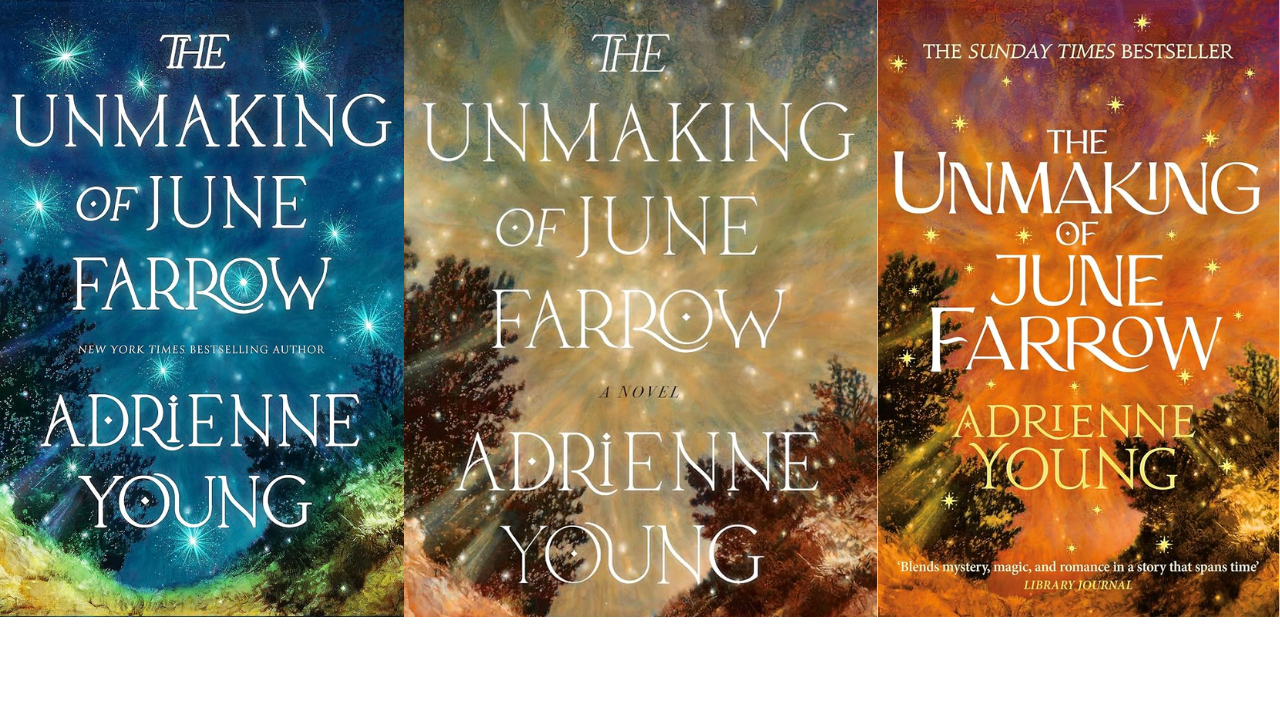
The Unmaking of June Farrow is yet another book I read in search of a perfect comparable title for my novel, Lu Patrick Easley and the Groovy Penguin Avenue. While this still didn't crack the code for what I was looking for, I'm still glad I get to read so many books by unique authors! This novel is a magic realism, time-travel romance—a fantastic combination. I was looking for a "dual timeline supernatural mystery with deep romantic elements", so I thought this'd be kinda close. Very different, though. All that being said, I had high hopes for this one. So, were my hopes met, crushed, or exceeded? That's what I, Brighton Nelson of Brighton's Bookshelf, will be discussing in today's article. Thanks so much for joining me today, and I hope you enjoy the article!
I'll start with the positives. June Farrow is a pretty fun character to follow, as we get to feel her descent into grappling with the existential crisis of her family curse. I also thoroughly enjoyed the plot twists and how they ratcheted up the tension, even if they weren't the most surprising. I also enjoyed the build-up to her entering the door: many books struggle to keep the preamble to the magic interesting, but this book did it well. The romance itself, while brief and only in full gear near the conclusion, works because of the curse's debilitating nature and how it affects relationship memory. While amnesia can feel cheap and unearned, it works well here because it amplifies and enriches the plot.
Also, magic amnesia almost always plays better, because the percentage of non-magic amnesia in books compared to the actual percentage of real-life clinical cases of amnesia? It's an astronomical, momentous disparity. The build-up, the payoff, and everything in between work wonderfully here, too, in the bare-bones plot itself.
My final major highlight is the atmosphere and tone. Both the present and the past are well-defined and mood-driven throughout the book, with a commendable attention to detail. It may not be as immersive as, say, an Amor Towles novel, but few things are. It's fantastic nonetheless.
That said, this book has some noticeable flaws that leave it on an underwhelming note. Three main flaws stand out: the time-travel mechanics, the lack of acknowledgment of the finale's ramifications, and the uncanny nature of June's personality throughout the plot.
First: the time travel mechanics. I know that nearly every time travel story requires a suspension of disbelief, but this novel simply was too loaded to grasp its mechanics. At some point, I wonder why any of this was even allowed to happen: why didn't her family just tell her, "don't go through the door, the cost is far too great"? I understand ending the curse, but... Can it even be considered a curse with book-worthy stakes if it's entirely preventable? The fact that the time travel struggled to make sense on a magic, scientific, and character-centric level? I was left underwhelmed.
Second: the problematic ending. Without spoiling anything, I'll just say: the ending of the book is a holistic whimper. Okay, the next paragraph is all spoilers: so don't read it if you don't want spoilers!
The main problem here is the lack of acknowledgment that it's a tragic ending. Let me explain. The ending reads as if the author doesn't understand how melancholy her own finale truly is. Mason is left traumatized by not knowing the fate of the girl he loved. Conversely, it feels like June conveniently forgot how much his existence meant to her. He ended up being crammed into a corner, only pulled out when June's character arc needed more drama and a mediocre love triangle. It got to the point where June and Mason felt too much like caricatures, and I was taken out (and taken aback) by the novel. When it comes to her grander family, because June doesn't reflect like a normal human, she feels like a selfish brat: the curse is only broken for her, while her whole family suffers their entire lives just to make her happy.
Even acknowledging their sacrifice for a page or two would ground the novel emotionally. More so, adding one more child of June's or Birdie's would make way more sense given the author's lean toward an optimistic ending. If the novel were inherently nihilistic or cynical, such an ending would be fine—provided it was framed correctly. But it isn't. The fact that there's no additional child means breaking the family curse was practically useless... yet the book completely fails to play it off as such. Alright: spoilers over.
Third, June's uncanny personality: the biggest blunder here. I struggle to believe June would act the way she did. She never internalizes the lack of technology and isn't affected by not being assimilated or by being a fish-out-of-water in any way. I mean, her personality makes it feel like she doesn't really have a life before the time jump. This feels especially fake with Eamon... He's a cool character, but the book needed to acknowledge that he was different for the time period. He needed to be some sort of women's advocate or something for the story to make sense—and June needed to acknowledge that. Otherwise, it just feels like the author is out of touch. I'm okay with June being more attuned to the olden-day lifestyle than others, especially given her upbringing on a farm, but this isn't it.
One could also say previous June's mentality, countenance, and strength carried over to the new June, making her more prepared... However, that means previous June is the character dealing with harder emotions and a far more moving arc. It begs the question: why didn't the book follow the less passive past June's story in real time and give us a true dual-timeline perspective? Or, just make it the one perspective we follow, as it is obviously the more important version of her? I feel the ending and the emotional disconnect are the two biggest wedges that prevent this book from embracing the excellence of its other elements.
The Brighton's Bookshelf Verdict
Brighton's Bookshelf Score - 5/10
Letter Score - C
The Unmaking of June Farrow has serious strengths. Still, its inability to surmount its structural, narrative, and character problems makes its effective, mysterious, and atmospheric elements the exception, not the rule.
Interested in checking out some of my other fantasy, mystery, romance, and SF novel reviews? Check them out below!
 Author BioAuthor BioAuthor BioAuthor Bio
Enjoy this review? Stay tuned for more articles from Brighton's Bookshelf! Enjoy video games, films, or music? Check out our sister sites, RPG Ranked & The Reel Ranker & Mr. Maestro, respectively!